
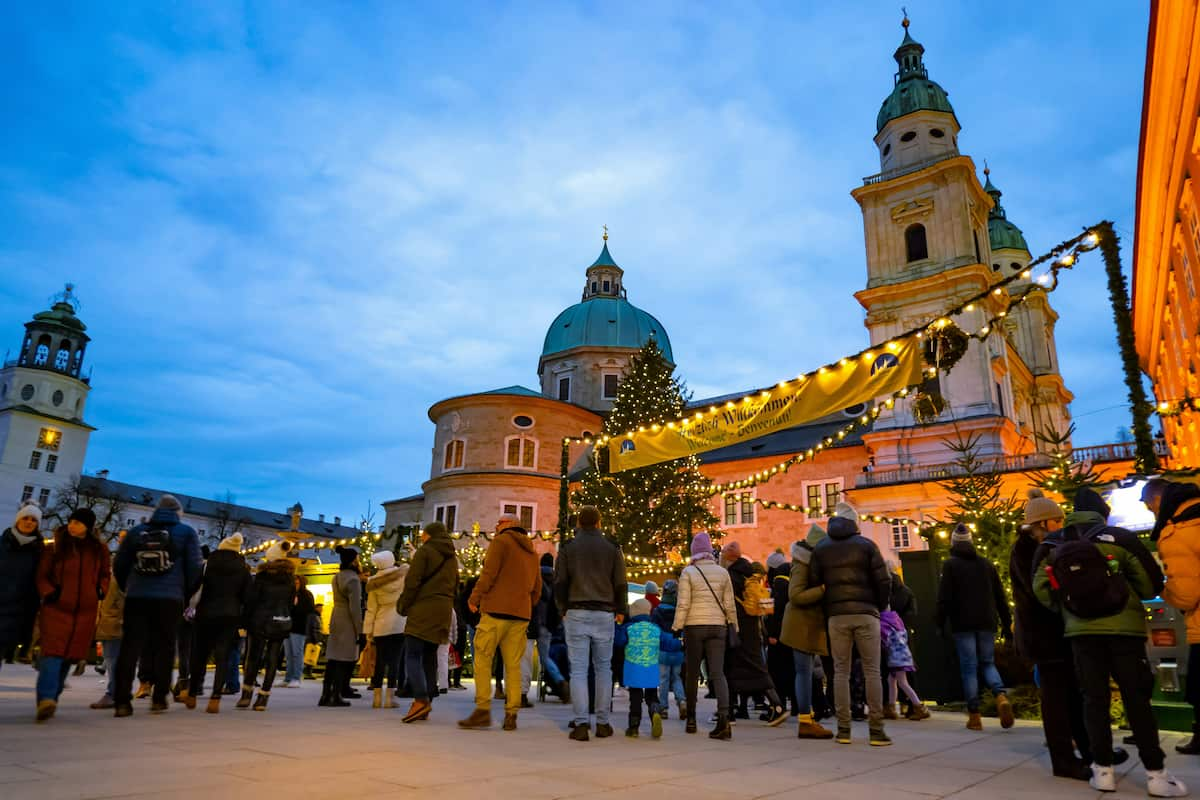
There is an unmistakable magic to winter in Europe, but nothing compares to experiencing the best Christmas markets in Europe in full swing.
Having lived in Rome through two full winters, I still vividly remember the sensory cues of the season —the damp chill over travertine cobblestones, the hiss of street braziers roasting fresh caldarroste (chestnuts), and quiet neighborhood piazzas glowing under warm lantern light. While Piazza Navona has a traditional holiday market, it is a bit modest compared to the grander spectacles across Europe.
We found a similar, hushed charm spending Christmas in Venice (which we explore in our guide to the best European cities to visit in December).
However, when you head north across the Alps, winter transforms into a grand, open-air celebration. Historic town squares across France, Germany, Austria, Switzerland, and the Czech Republic come alive with hand-carved wooden chalets, bubbling raclette, and the spiced aroma of steaming Glühwein.
If you are searching for genuinely good Christmas markets in Europe rather than commercial tourist traps, this guide breaks down the essential routes: authentic regional foods (with vegan options), train connections, neighborhood stays, and some tips to make your adventure truly awesome.
What to Know Before You Go: 4 Essential Market Rules

- The Mug Deposit System (Pfand): When buying hot Glühwein or punch, you will pay a deposit (typically €3–€5) alongside the drink price. Return the commemorative mug (and sometimes the colorful or metal token) to get your cash back, or keep it as an authentic, low-cost souvenir.
- Cash: While Basel, Strasbourg, and Prague accept contactless cards almost everywhere, traditional German and Austrian stalls remain heavily cash-reliant. Always keep €1 and €2 coins handy for vendors who don’t accept credit cards and for public restrooms.
- The “Blue Hour” Sweet Spot: Browse stalls between 10:30 AM and 1:00 PM for less busy artisan shopping, head back out between 4:00 PM and 5:30 PM (twilight) for photography, and aim to finish eating before 6:30 PM when local evening crowds arrive.
- Closing Dates: Most German and Austrian markets close strictly by midday on December 24. If you are traveling between Christmas Day and New Year’s, focus your itinerary on Prague or select Austrian palace grounds.
- Smart Train Planning: When piecing together cross-border routes (like Strasbourg into Basel, or Dresden down into Prague), multi-country third party booking apps like Trainline or Omio trains are helpful to map out connections and times of national networks in a single screen. However, we recommend booking directly on the national carrier’s app (such as Deutsche Bahn’s DB Navigator, France’s SNCF Connect, or Austria’s ÖBB). Third party apps can send SMS trip updates, but during winter weather disruptions, official carrier apps provide instant, zero-lag platform changes, simpler one-click rerouting if a train is canceled, and seamless EU delay compensation. We have been rerouted so many times when freak storms happen!
Route 1: The Alsace & Upper Rhine Trail
1. Strasbourg, France (The Capital of Christmas)

Dating back to 1570, Strasbourg’s Christkindelsmärik sprawls across the central river island. Its centerpiece is Place Kléber, featuring a towering natural fir tree set against the pink sandstone of the Cathédrale Notre-Dame. For an alternative vibe, explore the “OFF Market” at Place Grimmeissen in Petite France, which features upcycled shipping containers, second-hand winter gear, fair-trade crafts, and local organic bites.
How to Get There: Direct 1h 45m high-speed TGV inOui train from Paris Gare de l’Est to Strasbourg-Ville.
Where to Stay: Hôtel Régent Petite France & Spa, built inside a converted 17th-century ice house and mill overlooking the locks.

Food & Drink: For sheer history, book a table inside Maison Kammerzell right on Cathedral square—a 15th-century wood-carved landmark with leaded windows famous for its three-fish choucroute (sauerkraut) – just know this is a highly touristy spot.
For a more intimate culinary experience, head around the corner to Winstub Meiselocker on Rue des Frères for house-made choucroute garnie and slow-cooked baeckeoffe in a wood-paneled dining room. At the market chalets, sip steaming cups of vin chaud blanc (spiced Alsatian white wine) and grab bags of Bredele (traditional spiced butter-almond cookies).
Plant-Based & Vegan Picks: Snack on hot roasted chestnuts (marrons chauds) and molasses-sweetened spice bread at the chalets, then head to Harmonie Bowl & Juice on Place Saint-Étienne for warm, organic noodle and grain bowls paired with fresh juices and cozy winter herbal infusions.
2. Colmar, France (The Storybook Village)

Colmar actually has six micro-markets located between canal bridges and pastel half-timbered houses in the “Little Venice” quarter. A beloved highlight is Les Barques des Enfants, where local children’s choirs sing carols from illuminated wooden flat-bottom boats drifting down the canal on some December evenings.
How to Get There: Frequent regional TER Grand Est trains take 30 minutes from Strasbourg station.
Where to Stay: Hôtel Le Maréchal for a historic 1565 timber-framed home stay right along the Little Venice canal, or La Maison des Têtes (Relais & Châteaux) for five-star historic luxury inside a landmark 1609 stone-carved building.
Food & Drink: Step inside the red-brick 1865 Marché Couvert at the edge of Little Venice, where you can grab a canal-side counter seat for hot spiced cider, regional Alsace wines, and fresh charcuterie platters.
Around the market squares, grab freshly baked Flammekueche (thin-crust flatbread with crème fraîche, bacon, and onions) or sweet, sugar-dusted Kugelhopf brioche.
Plant-Based & Vegan Picks: Grab a steaming skillet of garlic-sautéed wild mushrooms (poêlée de champignons) with fresh bread and spiced hot cider along Little Venice, or slip inside the historic Marché Couvert to Cuit Lu Cru for hearty lentil bowls, seasonal vegetable soups, and organic tartines.
3. Basel, Switzerland (The Swiss Riverfront Gem)

Set across Barfüsserplatz and Münsterplatz beside the red-sandstone cathedral overlooking the Rhine, Basel has one of Switzerland’s best markets. Be sure to stop by the inner courtyard of the historic Rathaus (City Hall) on Marktplatz to hand-write a holiday wish in the massive, leather-bound Basler Wunschbuch (Wish Book), a town tradition running since the 1970s.
How to Get There: Direct 50-minute TER train south from Colmar, or a 10-minute bus/train link from EuroAirport Basel-Mulhouse-Freiburg.
Where to Stay: Grand Hotel Les Trois Rois, one of Europe’s oldest historic riverfront hotels, featuring an open fireplace and a massive, lavishly decorated tree in its central lobby – even if you don’t stay there, go to check out the tree.
Food & Drink: Cross the river into Kleinbasel to Restaurant Fischerstube on Rheingasse. It is the birthplace of craft Ueli Bier (brewed on-site since 1974) and features a cozy, wood-paneled dining room serving house-made beer sausages (Ueli-Bierschüblig), hot Swiss fondue, and winter ales.
At the stalls on Münsterplatz, order bubbling raclette scraped straight from heated half-wheels onto boiled new potatoes with cornichons, followed by spiced Basler Läckerli honey cakes.
Plant-Based & Vegan Picks: Look for open-flame grilled garlic bread (Chnoblibrot—olive oil and herbs only) and roasted Swiss Marroni across Münsterplatz. For a sit-down meal, reserve at LAUCH in Kleinbasel for creative winter plant-based dining, or the expansive hot buffet at tibits Basel on Stänzlergasse both are vegetarian but have plenty of vegan options.
Route 2: The Bavarian & Saxon Heartlands
4. Nuremberg, Germany (The Living Tradition)

Nuremberg’s Christkindlesmarkt on the central Hauptmarkt remains the gold standard of German holiday tradition. Artificial garlands and mass-produced plastic trinkets are strictly banned; every stall is built with native spruce fir and fabric. Just north on Rathausplatz, explore the Markt der Partnerstädte (Sister Cities Market), showcasing authentic food and handcrafted goods from twin cities around the world, from Kraków to Glasgow.
How to Get There: Direct 1-hour ICE train north from Munich Hauptbahnhof, or 2 hours from Frankfurt.
Where to Stay: Hotel Drei Raben, a boutique design hotel inside the historic city walls where every room is styled around a local Nuremberg folktale.
Food & Drink: Dine at Historische Bratwurstküche “Zum Gulden Stern”, operating on Zirkelschmiedsgasse since 1419, where authentic Nürnberger sausages are grilled over an open beechwood fire right in the dining room and served on historic pewter plates.
On the Hauptmarkt, grab “Drei im Weggla” (three grilled sausages in a crusty round roll with mustard) and pick up certified PGI Original Nürnberger Elisenlebkuchen made with rich nuts and winter spices (German gingerbread).
Plant-Based & Vegan Picks: Nuremberg’s market features dedicated chalets dishing out certified pea-protein vegane Rostbratwürste in crusty rolls (sausages) and egg-free Elisenlebkuchen – gingerbread (look for Fraunholz bakery). For dinner, head to bodhi for hearty Bavarian plant-based comfort food, including vegan schnitzels and dumplings in rich dark gravy.
5. Rothenburg ob der Tauber, Germany (The Medieval Postcard)

Rothenburg’s Reiterlesmarkt sits completely enclosed within intact 14th-century city walls. To take in the view, climb the 220 steps and ladders of the Rathausturm (Town Hall Tower) out onto the narrow open balcony for a panoramic look down at the illuminated gables and stalls of Marktplatz.
How to Get There: Regional train via Steinach (Bavaria), taking a quick 15-minute connecting shuttle (RB 82) into Rothenburg station.
Where to Stay: Historik Hotel Gotisches Haus, an intimate 13th-century Gothic patrician manor on Pfaffengasse featuring vaulted stone rooms, clawfoot tubs, and authentic medieval character just steps from Marktplatz.
Food & Drink: Spend an evening at Zur Höll (“To Hell”), housed inside a 1,000-year-old stone building on Burggasse. It is a candlelit tavern serving Franconian red wines poured from regional Bocksbeutel bottles, slow-cooked meats, and savory stews (reservations are recommended).
While walking the medieval lanes, try a Schneeball (“Snowball”)—strips of shortcrust pastry shaped into a sphere, deep-fried until crisp, and rolled in powdered sugar or chocolate.
Plant-Based & Vegan Picks: Fuel up at the stalls on crispy fried potato pancakes (Kartoffelpuffer) with sweet applesauce and bags of warm cinnamon-roasted almonds (Gebrannte Mandeln). For coffee, lunch, or sweets, visit Café Einzigartig, an eccentric vintage spot serving dedicated vegan breakfast boards, daily plant-based soups, and house-baked vegan cakes.
6. Dresden, Germany (The Historic Pioneer)

Founded in 1434, the Dresden Striezelmarkt on the Altmarkt is Germany’s oldest documented Christmas market. Its signature landmark is the 14.6-meter-tall Erzgebirge Step Pyramid, the world’s largest playable wooden pyramid, featuring six rotating tiers of hand-carved figures.
How to Get There: Direct 1h 50m EuroCity/Intercity train south from Berlin Hauptbahnhof.
Where to Stay: Hotel Bülow Palais, an elegant manor retreat in the historic Baroque Quarter (Innere Neustadt), a short walk across the river bridge.
Food & Drink: Head underground into the Pulverturm an der Frauenkirche, a stone-vaulted 1565 gunpowder fortress cellar where staff in period dress serve roasted meats, Saxon dumplings, and dark draft beers by torchlight.
At the Striezelmarkt stalls, pair a mug of warm Glühbier (spiced cherry or dark ale) with an authentic slice of Dresdner Christstollen – fruit bread- bearing the official golden seal of the Stollen Bakers’ Association.
Plant-Based & Vegan Picks: Pick up a golden-sealed vegan Dresdner Christstollen (fruit-bread) from certified bakeries like Bäckerei Heller, which craft dairy-free loaves adhering to the historic spice and candied-citrus profile. In the lively Neustadt district across the river, Steffenhagen serves classic Saxon tavern comfort food, from house-made seitan roasts to potato dumplings in rich gravy.
Route 3: Imperial Grandeur & Central Europe
7. Vienna & Salzburg, Austria (Palaces & Alpine Choirs)

Vienna pairs grand imperial backdrops with holiday cheer, from the lively Christkindlmarkt at City Hall (Rathausplatz) to the artisan village outside Schönbrunn Palace. In Salzburg, the market centers on Residenzplatz beneath the cliffside fortress. Don’t miss the Salzburger Turmblasen, where brass ensembles play carols from the cathedral towers down across the market square on Thursday and Saturday evenings.
How to Get There: ÖBB Railjet trainsconnect Vienna Hauptbahnhof and Salzburg Hbf in about 2 hours 25 minutes.
Where to Stay: Hotel Sacher Wien in Vienna for classic holiday salon luxury, or Hotel Goldener Hirsch in Salzburg, an authentic 600-year-old inn on the Getreidegasse.
Food & Drink: In Vienna, the three-level underground cellar of Zwölf Apostelkeller offers historic Roman brickwork and live Schrammel music, though the food is standard tourist fare; for a standout culinary meal, book Gasthaus Pöschl for golden veal Wiener Schnitzel and rich beef goulash in an intimate, classic tavern setting.
In Salzburg, slip into Augustiner Bräu Kloster Mülln, where monastery-brewed beer is poured straight from wooden casks into stone steins alongside an indoor food arcade serving roast pork and warm pretzels. At the stalls, enjoy shredded sweet Kaiserschmarrn (pancakes) with stewed plums or curry-spiced Bosna sausages.
Plant-Based & Vegan Picks: At Vienna’s Spittelberg and Karlsplatz (Art Advent) markets, look for warm garlicky Lángos (deep-fried Hungarian yeast flatbread brushed with garlic oil—ask for no cheese/sour cream) and organic vegan Kaiserschmarrn with stewed plum compote.
For dinner, reserve at Tian Bistro am Spittelberg in Vienna for creative plant-based dishes; in Salzburg, head across the river near Linzer Gasse to GustaV, an all-vegan bistro serving hearty daily winter specials, warm soups, and house-made sweets.
8. Prague, Czech Republic (Gothic Spires & Extended Dates)

Set beneath the twin spires of the Church of Our Lady before Týn, Prague’s Old Town Square market has a Gothic winter atmosphere. A major perk is the Old Town Square Tree Animation: every hour on the half-hour during the evening, the lights across the massive mountain spruce pulse to synchronized classical orchestral pieces like Smetana’s Vltava. Best of all, stalls remain open through January 6.
How to Get There: Direct 2h 20m scenic EuroCity train south from Dresden along the Elbe River, or a direct 4h 10m Railjet train north from Vienna Hauptbahnhof.
Where to Stay: The Grand Mark Prague, a 17th-century residential baroque palace near the center featuring an illuminated winter courtyard garden.
Food & Drink: For Czech comfort food, head to Restaurace Mincovna right on Old Town Square in the historic former royal mint building for svíčková (braised beef in spiced root-vegetable cream sauce with bread dumplings) and tank Pilsner.
If you want a historic drinking landmark, drop into U Zlatého Tygra—famous for Bohumil Hrabal and Bill Clinton’s visit—for fresh Pilsner Urquell, though expect a loud, unpolished hall with brusque service and simple cold beer snacks rather than a full dining room.
In the square, watch whole Prague hams (Pražská šunka) roast over beechwood fires, paired with warm Svařák (spiced wine).
Plant-Based & Vegan Picks: Stalls on Old Town Square fry up piping-hot Bramboráky (traditional Czech potato pancakes seasoned with fresh garlic and dried marjoram), as well as whole sweet corn cobs char-grilled over open coals. For dinner, head just off the center to Restaurace Střecha for plant-based svíčková (cutlets in spiced root-vegetable cream sauce with steamed bread dumplings).
Where Are the Best Christmas Markets in Europe?

If you are wondering where are the best Christmas Markets in Europe, it really depends on what you enjoy and when you are planning on going.
For Maximum Fairy-Tale Charm: Head to Strasbourg & Colmar. No other place matches the scale of these holiday shop displays and historic, canal-side houses.
For Strict Historical Tradition: Choose Nuremberg & Dresden. Hand-carved Ore Mountain wooden nutcrackers, strict artisan standards, and centuries of baking history make these the purest German experiences.
For Travel After December 25: Head straight to Prague & Vienna (Schönbrunn). While German markets pack up by Christmas Eve, these retain their festive atmosphere into the New Year.
Have you visited any Christmas markets in Europe or closer to home? If you are spending winter in Vancouver, our local favorite is the Shipyards Christmas Market in North Vancouver—with its wooden chalets, glühwein, and waterfront skating, it brings an authentic slice of European holiday charm right to British Columbia.
What are your favorite holiday markets around the world? Let us know in the comments below!