
Last Updated on October 13, 2026 by Masha
This was my second trip to Namibia, but my first time actually seeing it from the comfort of a car.
In February 2010 I was out in the Namib Desert with the Project Athena team, running the Namib Desert Challenge. It’s a five-stage, 220 km (136 mile) self-supported ultramarathon. Everything I owned for the week was on my back, water was rationed at checkpoints, and the only “attractions” I cared about were the next checkpoint and the finish line.
The second time, in June, we stayed for two weeks and did it the other way around. We rented a car in Windhoek and drove a big loop through Etosha, Spitzkoppe, the Skeleton Coast, Swakopmund, Walvis Bay and Sossusvlei. And this time we stopped at every highlight we could. There was no tour group and no itinerary somebody else wrote.
As always, nobody paid us or hosted us, so every recommendation here is real.
In this post we share the loop, the Namibia tourist attractions that were worth the fuel, what we paid, and the logistics we’d want to know before turning the key.
Why I Went Back to Namibia After Running Across It

The race which took place around Sossusvlei, in the Namib-Naukluft National Park was during the last two weeks of February 2010. The weather was fabulous, and we saw plenty of animals. The start was at the base of the mountains near Sossusvlei Lodge, and stage one alone was a full marathon (42.2 km) on a sandy jeep track.
After that the stages ranged from 25 to 55 km, crossing soft sand, gravel plains, rocky hills, the dry Tsauchab riverbed and the walls of Sesriem Canyon. We climbed some of the biggest red dunes on earth, including Dune 45 and Big Daddy, the “Crazy Dune” and finished with steep, dizzying descents into the white clay pan of Deadvlei.
What I remember most was the heat! Even though daytime temperatures were around 40°C (105°F), on the sand starting in the late morning I remember it feeling closer to 50°C (122°F). The heat was seriously dizzying.
My teammate and good friend, who is one of the strongest people I know, was bonking badly. She was so out of it, that she was begging me to just leave her behind. So I towed her for the first day and on the big dune days. We were definitely not the fastest but we finished together and alive!
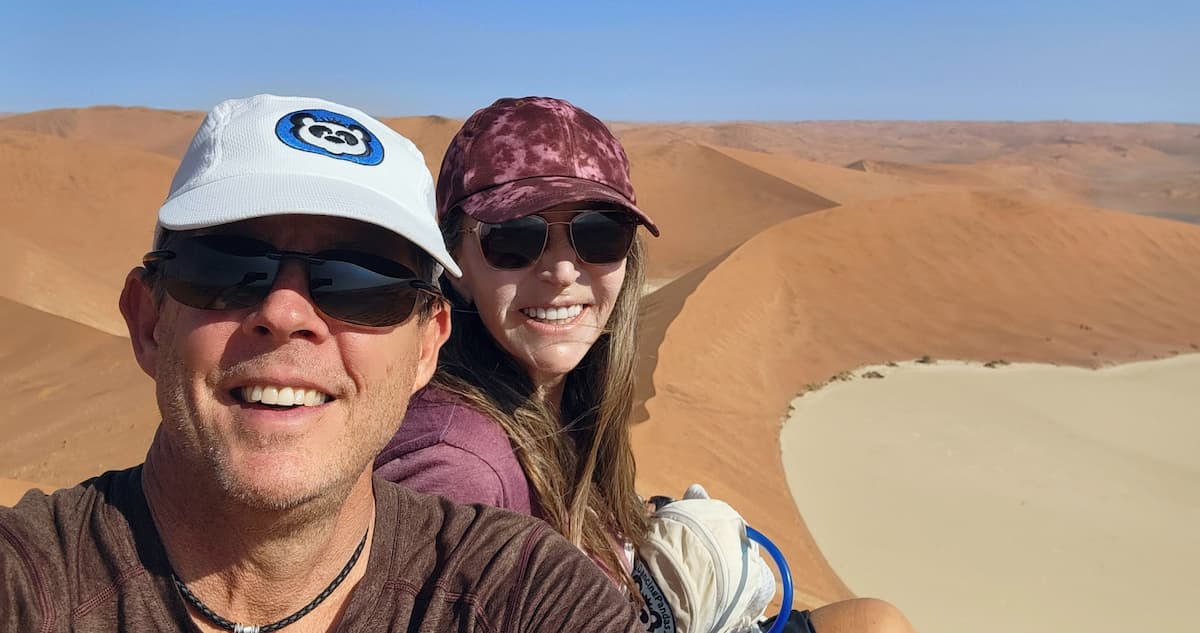
Standing in Deadvlei this time felt surreal. Instead of a race bib, blisters, and an urgent race clock, I had a water bottle, a camera, and Rob by my side. I could actually stop and look at the landscape rather than just surviving it.
Our Namibia Safari Self Drive Setup

We rented from Europcar in Windhoek, and it was the cheapest option we found at $56 USD per day for an AWD Toyota RAV4. We were glad we didn’t pay for a 4×4 for the whole trip. If you’d rather rent locally, Kalahari Car Hire is a female-run agency in Windhoek. Their 4x4s are typically around $100 USD per day.
Here’s the reality: distances in Namibia are long, and a lot of the roads are gravel. Namibians drive on the left. The main B roads are tar, but many of the C and D roads we used were gravel.
These are the distances that we drove on our loop:
- Windhoek to Etosha’s Andersson Gate: about 415 km (258 miles), roughly 4.5 hours on tar
- Etosha to Spitzkoppe: about 400 km (249 miles), roughly 4.5 hours on mixed tar and gravel
- Spitzkoppe to Swakopmund and Walvis Bay: about 150 km (93 miles), roughly 2 hours on tar
- Walvis Bay to Sesriem (via Solitaire): about 315 km (196 miles), roughly 4.5 hours on gravel
- Sesriem gate to the 2×4 parking area at Sossusvlei: about 60 km (37 miles) on tar
- Sesriem to Windhoek: about 320 km (199 miles), roughly 4.5 hours on gravel and tar
Fuel stops in the desert are far apart, so we needed to preplan the refuel stations and topped up at Henties Bay, Swakopmund, Solitaire and Sesriem.
Tip: Being vegan actually saved us a headache at the Etosha gates. Namibia has veterinary cordon checkpoints (the “Red Line”) to prevent disease, and guards will inspect your cooler when you leave.
Raw meat cannot cross south out of the park. Since we only had vegetables and tofu, we breezed right through, but if you travel with meat, you’ll need to eat it before you exit.
Where We Stayed and What It Cost

- Windhoek, Kuiseb House: About $160 USD per night.
- Etosha: Etosha Village, located just outside Andersson Gate, with dinner and breakfast included was $140 USD per person during low season when we went (June). In July rates go up to $160 USD. Camping sites are $20 USD per person.
- Spitzkoppe, Spitzkoppe Cabin Camp: About $190 USD per night. It’s a cute guesthouse inside the park, and it has a kitchen.
- Walvis Bay, Mukulela Guesthouse: About $56 USD per night, lovely and reasonable.
- Sesriem, Desert Quiver Camp: Three nights at about $200 USD per night, which covered everything in the south.
The Namibia Tourist Attractions We’d Go Back For
Etosha: Three Days at the Waterholes

We stayed at Etosha Village, the hotel right outside Andersson Gate. Our hut looked out over the sunsets, and the guesthouse fed us, which mattered because there was nothing else nearby. After dinner the staff always walked us back to our guesthouse. They were worried about the animals wandering around wanting to snack on us, and honestly, so were we.
The park is the main event. We spent hours at the waterholes, where the picture never stayed the same for long. New animals kept arriving to drink, then rest, then make room for the next group.
This is everything we saw in Etosha:
- Big cats and other predators: Lions, leopards, cheetahs, spotted hyenas, black-backed jackals, bat-eared foxes and honey badgers
- Big animals: Black rhinos, elephants and giraffes
- Zebras and antelope: Burchell’s zebras, Hartmann’s mountain zebras, springbok, blue wildebeest, oryx (gemsbok), greater kudu, red hartebeest, black-faced impala and Damara dik-dik
- The rest: Warthogs and ostriches
Three waterholes stood out:

- Okaukuejo: Widely considered the best all-around waterhole in the park. It has bench seating right against the perimeter fence. Black rhinos are the main draw and tend to arrive in groups between 9:00 PM and midnight. Elephant herds push each other for the freshest water.
- Moringa, at Halali Camp: One of our favourites. It’s in an amphitheatre-like setting surrounded by rocky boulders and mopane trees. It’s quieter than Okaukuejo, and it’s popular with leopards, elephants, and several black rhinos.
- King Nehale, at Namutoni Camp: It sits next to the historic German fort on the eastern side of the park, drawing elephants and lions out of the surrounding eastern woodlands during the day.
We visited the waterholes exclusively during daylight hours. Etosha’s gates open strictly at sunrise and close at sunset; observing the waterholes after dark requires staying overnight inside one of the government-run Namibia Wildlife Resorts camps inside the park gates, which we didn’t do.
Entry fees are paid at the gate, and everyone has to show ID. The cost for foreigners was N280 (approximately $17 USD) + N60 per vehicle per day ($4 USD) which is a bargain compared to Kruger or many of the other safaris in nearby countries.
Spitzkoppe: Climbing With Ropes and Chains

After three days in Etosha we drove the 400 km (4.5 hour drive) to Spitzkoppe stopping for lunch at the Erongo Mountain Winery for some amazing food (you can also have some wine and drinks here), although we decided to pass as we still had some driving to do after.
By late afternoon we ended up in Spitzkoppe Cabin Camp, a cute guesthouse inside the park. Just driving through the park was incredible and climbing the granite using the ropes and chains fixed to the harder sections brought us up to amazing views showing off the rock formation of the area.
Every ledge seemed to have something new on it, like a view or a pool of shade. We also found ancient rock paintings of animals in the caves and under overhangs. The Rock Arch is here too – make sure to visit it! This place somehow reminded us a bit of Jordan’s Wadi Rum.
Having a kitchen made it an easy base for a few days. Access to the reserve needs a permit N180 or ($11 USD per person per day), and there’s a bar and a restaurant on site. Spitzkoppe is a protected heritage site, so we kept our hands off the rock art.
You can also camp in Spitzkoppe at N300 ($18 USD) per night per person (but this needs to be booked in advance) through the Spitzkoppe Namibia site.
The Skeleton Coast and Cape Cross

From Spitzkoppe we headed to the coast through Henties Bay. The Skeleton Coast is immense, flat and often foggy. We saw whale bones on the sand and the rusting remains of old shipwrecks. The name also comes from the sailors who were stranded on this coast. It feels so vast, haunting, real and raw.
Cape Cross is a short drive north of Henties Bay. It’s a Cape fur seal colony (named for their thick coats and southern African origins), and up to 210,000 seals can be there at the peak of the breeding season in November and December.
🚧 A note on the gates: The Skeleton Coast Park gates at Ugabmund and Springbokwasser open at sunrise (about 7:00), and the last entry is 15:00. A late start from the coast doesn’t work. Entry is free.
Swakopmund: German Streets, a Lighthouse and the Mole
We continued south to Swakopmund, a small German colonial town with a lighthouse and a sea wall called the Mole. The Mole was built in the early 1900s as part of a harbour that kept silting up. It’s an easy town to walk around, and a good place to restock before the desert.
Walvis Bay: Flamingos and the Sandwich Harbour Tour

We stayed at the Mukulela Guesthouse in Walvis Bay for about $56 USD a night, lovely and reasonable.
The waterfront and the bays filled with pink flamingos are worth a slow afternoon. When hundreds of them wade across the lagoon in unison, shifting like a single, slow-moving wave of pink against the water, you immediately understand why a group of flamingos is officially called a flamboyance.
Even if you have your own 4X4 we still highly recommend the Sandwich Harbour 4×4 tour with Red Dune Safaris. Going to Sandwich Harbour on your own is just not possible (illegal), and it’s genuinely hazardous. The beach route is passable only at low tide, there’s no phone reception, and the sands shift. Only licensed guides and vehicles are allowed in.
The highlight is the Sandwich Harbour dune belt, where tall, steep sand dunes drop straight into the Atlantic. There’s also the Sandwich Harbour lagoon and the high dune lookouts. We chose an early-morning departure.
The morning light is usually best for photographing the pink salt lakes, while an afternoon departure often brings more dramatic dune shadows. The cost of this tour ranges from $135 USD for a half day to about $250 USD for a full day depending on the package you choose.
The Grotto, Between Walvis Bay and Solitaire

Driving from Walvis Bay, a cave called The Grotto makes for a worthwhile detour. It is located at Schlesien, right next to the C14 road toward Solitaire, and makes a lovely stop. The dirt track to the site runs about 5 km (3 miles) each way.
While a proper 4×4 can reach the entrance, our AWD only made it partway through before the sand turned soft. Rather than risking it, parking on the firmer ground and walking the rest of the track proved to be the smarter move. It is a solid spot for a picnic, though easy enough to skip if daylight is running short.
Solitaire: An Interesting Stop

Solitaire is the stop between Walvis Bay and the Sossusvlei dunes. It has fuel, a bakery and a small shop. We were glad to have it on both legs of the trip as it is one of those curious one horse town stops. Rob ate the apple pie, which everyone talks about. It wasn’t vegan, so I watched on with great envy.
Sossusvlei: Three Nights at Desert Quiver Camp

Desert Quiver Camp served as our base for three nights to see everything in the south. At about $200 USD per night, it was worth every penny. The little eco houses sit right out in the open desert, drawing different animals to the patio each evening.
The regular was a desert fox, who turned up every night. We guess someone had been feeding him and he hoped we would do the same. It was so hard not to oblige, but we followed the rules and just enjoyed his company.
Sossusvlei has one entrance, at Sesriem, and permits are bought at the office there. If you prefer, you can purchase your tickets in Windhoek prior to leaving at the MEFT headquarters or the regional office in Swakopmund to purchase your physical permits in advance. The cost is N280 ($17 USD) per person per day and N60 ($4 USD) for the vehicle per day. This is what we visited from our base:

- Sesriem Canyon: A gorge about 30 m deep, carved by the same Tsauchab River I’d stumbled along in 2010
- Elim Dune: About 5 km from the gate and an easy add-on
- Dune 45 viewpoint: 45 km from the gate, which is where the name comes from
- Big Mama dune: One of the big dunes along the road
- Deadvlei Hiking Trail: A white clay pan about 1 km on foot from the end of the track
- Big Daddy dune: Around 325 m tall. Climbing it with no pack and no race clock felt very different from 2010
- Hidden Vlei: A walk away from the main crowd
- Sossusvlei: The pan itself, at the end of the deep-sand section
Because these Namibia attractions are clustered relatively close together, having one base for three nights gave us the perfect amount of time to see them all without rushing.
Since our car was an AWD, we had to park at the 2×4 parking area and take the shuttle into Sossusvlei for the last 5 km of deep sand. If you have a true 4×4 and deflate your tires, you are allowed to drive this last bit yourself, but with our RAV4, taking the shuttle worked well and we’d do it the same way again.
The One Namibia Safari Splurge We’d Repeat

Sossusvlei is the best place we know for a hot air balloon flight, and Namib Sky Balloon Safaris is the company to book. We can highly recommend them, and we have no affiliation, so this is a real recommendation. Be prepared, though, as the cost is painful fluctuating between $600 and $675 USD per person.
Flights take off at dawn. The wake-up call is around 4:30 to 5:00 AM to get to the launch field before the sun comes up, and the crew picks you up from nearby desert lodges. The flight is about an hour, and you float above the dunes, the cracked clay pans and the fairy circles (the bare round patches in the grass).
The balloon then lands in the middle of nowhere, where the crew serves a champagne breakfast buffet right on the desert floor (and they can provide vegan options with enough notice). The views, the colors and the feeling up there can only be summed up as pure magic.
Back to Windhoek
We drove back to Windhoek and stayed at Kuiseb House for $160 USD per night, where we returned the Europcar car. Windhoek is a lovely city and an easy place to start and end the trip. If you have time visit the Namibia Craft Center as they have some of the best locally made things. The Coffee shop there, although touristy, has good options for a snack and drink.
The main square in town also has artisans selling different crafts – in 2010 I purchased a beautiful hand carved hippo made out of a single piece of wood and some bowls. Of course now, we don’t purchase things as we would have to shlep them around in our backpack.
Also consider visiting the National Art Gallery of Namibia as it has a nice representation of national talent and is free to enter.
Being Vegan in Namibia

Bottom line, being vegan in Namibia is challenging. Maybe not as challenging as in Niger, but still…. Meat is the focus of the food in Namibia, partly because of the dry climate and partly because of the culture. Outside the few main urban areas, there’s often very little on the menu for a vegan.
So I planned around it. Because I intermittently fast, I would only have to manage 2 meals for the day, making it slightly easier. I stocked up in Windhoek and Walvis Bay on nuts, dried fruit, bread, tofu and any vegetables and fruit I could find.
On the road I ate a lot of root vegetables. The kitchens at the Spitzkoppe cabin and at Desert Quiver made that much easier, and Etosha Village fed us because there was nothing else near the gate.
Planning Your Trip

When is the best time to go?
We went twice. In 2010 it was the last two weeks of February plus the first week of March, for the race, and the weather was fabulous with plenty of animals on safari. The second trip was two weeks in June (the end of the low season).
March and April are the shoulder season, and that’s when we’d go for the best value with good weather and animals still easy to spot. May to October is the driest and the coolest time, although let’s face it, Namibia is always pretty dry. We’d skip the summer, from December to mid-February. It gets really humid and hot, and it rains more.
A few timing details helped us plan:
- The Etosha waterholes are busiest in the dry season, roughly May to October although we saw plenty in the end of June.
- The Cape Cross seals peak in November and December
- The balloon flights usually pause for a few weeks from about late December to mid-February
Did we need a 4×4 for a Namibia safari self drive?

No. We rented an AWD Toyota RAV4 from Europcar for $56 USD per day, and it was fine on tar and gravel. We parked at the 2×4 parking area and took the shuttle at Sossusvlei, and walked in to the Grotto.
Sandwich Harbour needs a guided 4×4 tour anyway – you cannot take your own. A 4×4 from a local agency like Kalahari Car Hire typically costs around $100 USD per day if you really do want one.
How long did the loop take?
We spent 3 nights in Etosha, 2 nights at Spitzkoppe, 2 nights at Walvis Bay and 3 nights at Sesriem, 3 nights in Windhoek plus the driving days between them. In total the trip took two weeks.
How do the gates and permits work?
Etosha, the Skeleton Coast Park and Sossusvlei run on set gate hours, and fees are paid at the gates. Spitzkoppe needs a per-vehicle permit. Sandwich Harbour needs a permit and is done on a guided tour. Rates change, so we checked the official pages before each stop.
There is no bundled permit pass.
What did the trip cost?
The big items were the car at $56 USD per day, Desert Quiver at about $200 USD per night, Spitzkoppe Cabin Camp at about $190 USD per night, Kuiseb House at $160 USD per night, and Mukulela at about $56 USD per night.
For the main attractions and activities, the balloon ride was $650 USD per person, the Walvis Bay tour was $150 USD per person, Etosha entry with car was $21 USD per person per day, Sossusvlei entry with car was $21 USD per person per day, and Spitzkoppe was $11 USD per person.
Why Namibia Felt Different the Second Time

In 2010 I crossed these dunes on foot with a pack and a teammate in tow. This time we drove between them with a rental car, a desert fox visiting our porch, and absolutely no race clocks to watch for cutoffs. The desert was the same size and the dunes were just as steep, but this time we had time to look around and really enjoy this amazing country!
If you have questions about the route, the camps, the rental or anything else, leave us a comment below and we’ll do our best to help. And if you have visited some of the Namibia tourist attractions already, let us know what we missed so that we have something to come back to.