
Last Updated on September 29, 2026 by Masha
We’ve spent four decades tracking down the best things to do on Vancouver Island, and it still enchants and fascinates us—a new surprise around so many corners!
Rob actually grew up on part of it — his dad ran the government liquor store in Tahsis, then Campbell River, back when that was the only legal way to buy a bottle on the island. That made his family fairly well known in both towns, for reasons that probably don’t need much explaining.
Between surviving the muddy West Coast Trail (while having a dental emergency), finding the perfect rainforest singletrack, and tracking down hidden coves, we’ve figured out exactly where the best places to visit Vancouver Island actually are.
This is our list of Vancouver Island attractions, built from decades of actually being there and experiencing the greenest moss, the up close eagles and bears and the heat of the springs bubbling up beneath us – all pure joy!
Keep in mind, we are 100% independent and don’t get any freebies or any kind of compensation to write these recommendations.
Map of Vancouver Island Attractions
To make planning your own road trip easier, we’ve pinned all 25 of these best things to do on Vancouver Island—from the remote trail heads to the hidden coves—right here on this interactive map.
Wild Coastlines & Hidden Beaches
The west coast of the island doesn’t ease you into anything. The water is cold, the wind comes in sideways, and the beaches feel like they were built for storms, not sunbathing. That’s the appeal.
1. Find the Hidden Waterfall at Sombrio Beach
Sombrio Beach, south of Port Renfrew, is a surf beach on the Juan de Fuca Marine Trail. Most people stop at the sand and the waves. Fewer walk south along the shoreline to the slot canyon, where a waterfall drops into a small gorge cut right into the rock.
Check the tide tables before you go — the walk depends on the water being low enough to get around the point.
2. Walk the Sands of Chesterman Beach & Cox Bay in Tofino
This is where I nearly ended a family camping trip in the early 1990s. We were parked at Chesterman Beach in our 1974 VW Westfalia with our toddler son, and I tried to flip myself out of the pop-up bed one morning. I missed, and sheared the side of my hip and leg open on the corner of our propane fridge. I still have the lump and the scar, 36 years later, as a souvenir of Tofino.
That didn’t stop us from coming back, over and over. Chesterman and Cox Bay are still surf beaches first — you’ll see wetsuits before you see any bathing suits — but the town around them has filled in with cafes and shops that weren’t there when we were sleeping in a van.
3. Hike to the Remote Cape Scott Lighthouse
Cape Scott, at the far northern tip of the island, was where a group of Danish settlers tried to build a farming colony starting in 1897. They cleared land, built roads, and put cattle out to pasture, but the government wouldn’t extend a road out to connect them to any market, and the settlement slowly emptied out.
You can still find the remains of their cabins along the trail on the way to the lighthouse, which sits on its own at the edge of the continent.
4. Walk Among the Sea Stacks at San Josef Bay
If you make the drive up to the trailhead for Cape Scott Provincial Park but don’t have the time or gear to hike the full 18 kilometers to the lighthouse, San Josef Bay is the alternative. It is a flat, 45-minute walk through old-growth forest that opens onto hard-packed sand. The draw here is the geology: massive, tree-topped limestone sea stacks and deep sea caves carved by the Pacific waves. It is wild, windswept, and usually empty.
Rainforest Trails & High-Endurance Hikes

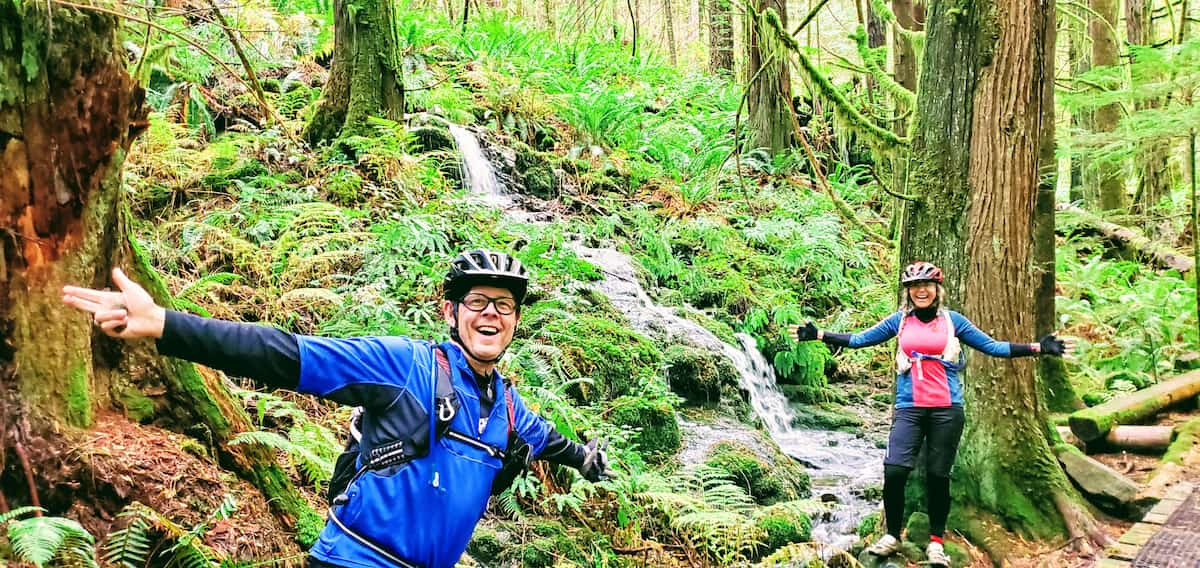
Some of our favorite hours on the island happened on two wheels, not two feet — mountain biking through mossy rainforest trails where the light barely gets through the canopy. In the fall, we’d pass people in the woods with buckets of chanterelle mushrooms, heading to sell them at the nearest farmers market. It’s the kind of forest where you half expect trail fairies to be dancing and jumping from leaf to leaf.
5. The Wild Pacific Trail in Ucluelet
This trail exists because of one man, Jim Martin — known locally as “Oyster Jim” — an oyster farmer from Colorado who moved to Ucluelet in 1979 and spent 16 years pushing for a trail society before the first section got built.
He went on to personally build a dozen kilometers of it himself. The easy 2.6 km loop trail follows the rocky shoreline out to the Amphitrite Point lighthouse, where there’s now a small interpretive center with daily naturalist programs.
6. The Juan de Fuca Marine Trail & Mystic Beach
The short walk in to Mystic Beach is the most accessible taste of the full 47-kilometer Juan de Fuca Marine Trail, which was built as a legacy project for the 1994 Commonwealth Games in Victoria.
You’ll cross a suspension bridge over Pete Wolfe Creek that’s high enough to make some hikers hesitate, and once you’re down on the beach, there’s a rope swing hanging from a tree that’s become one of the more photographed spots on the whole trail.
7. Alpine Scenery in Strathcona Provincial Park
Strathcona was designated in 1911, making it the oldest provincial park in British Columbia, and it covers more than 250,000 hectares of Vancouver Island’s interior.
The Paradise Meadows loop near Mount Washington is an easy boardwalk through subalpine meadows, but if you keep going toward Mount Becher, you get views of the Comox Glacier and Georgia Strait that make the climb worth it.
8. Walk Among Giants in Cathedral Grove
The Douglas firs here are up to 800 years old, with the tallest one on the Big Tree Trail standing 72 meters.
The name “Cathedral Grove” first showed up in government correspondence in the 1920s, reportedly coined by a Governor General who visited in 1928. The grove almost didn’t survive — it was owned by a logging company for years before H.R. MacMillan, the timber baron it’s now indirectly named after, donated the land to the public in 1944.
9. West Coast Trail

The West Coast Trail is considered by serious hikers Vancouver Island’s crown jewel, but it isn’t a manicured path—it’s a relentless, 75-kilometer slog through deep mud, massive wooden ladders, and slippery beaches In addition it requires logistics and a permit.
Originally an ancient First Nations trade route, it was turned into a lifesaving trail in 1907 to rescue shipwreck survivors from the ‘Graveyard of the Pacific.’
Most people take 6 to 8 days to survive this raw, rugged terrain. We did it in two, and not by choice. I had a tooth abscess before we started and stubbornly thought, this is fine, I can still cover 47 miles of the hardest terrain on the island in a couple of days.
We finished just in time to get back to Vancouver, where our friend Flo—a dentist—cleared the infection in the middle of the night, with her husband Roger holding the saliva ejector as her assistant. We spent the next two days recovering and eating soft foods at our favorite Vancouver vegan bakeries.
10. Hike to the Tofino Canso Plane Crash
The trailhead for this 1945 Royal Canadian Air Force Canso bomber crash site starts off the highway near Radar Hill. It’s roughly a 6-kilometer round trip (plan for 1.5 – 2 hours). You pass an abandoned WWII military radio building early on before the path narrows into the trees.
It used to be a notorious knee-deep bog, but raised boardwalks now cover the worst of the mud. It’s a straightforward walk through the forest that drops you right in front of a fully intact plane sitting directly on the forest floor (all 12 crew members survived the crash).
11. Trek to Landslide Lake
While Paradise Meadows is an easy boardwalk, Landslide Lake shows you the raw geology of the island. Located in Strathcona Provincial Park, this 22-kilometer round-trip trail climbs through the Elk River Valley. At the end, you reach an alpine lake sitting directly beneath Mount Colonel Foster, where a magnitude 7.3 earthquake in 1946 sheared the face of the mountain straight into the water.
Off-Grid & Active Adventures

Finding the best Vancouver Island hidden gems requires getting off the highway entirely — onto a boat, a kayak, or a trail that doesn’t show up on a regular map
12. Kayaking with Orcas in Telegraph Cove
Telegraph Cove started as a single-room telegraph shack used by loggers and fishermen to keep in touch with the mainland.
Today it’s a boardwalk village of about 20 people, and it’s the launch point for kayaking trips into Johnstone Strait, where orca sightings happen on most days between May and October. The first commercial whale-watching company on the island, Stubbs Island Whale Watching, started here in 1980.
13. Soak in the Remote Hot Springs Cove
Getting to Hot Springs Cove from Tofino takes either a 20-minute floatplane ride or a 90-minute boat trip with Ahous Adventures, a First Nations-owned eco-tour company. Because they also run dedicated wildlife tours out of Tofino, your ride to the springs often doubles as a whale-watching trip with sightings of greys, humpbacks, and the occasional orca. Once you dock, a 2-kilometer cedar boardwalk leads you through ancient rainforest directly to the geothermal springs.
The hot springs are entirely natural and rugged: steaming water cascades down a rocky waterfall into a series of small boulder pools. Because the pools step down toward the Pacific Ocean, the water gradually cools as it mixes with the incoming ocean swells, letting you find your perfect temperature right where the spring meets the tide.
This cove sits deep within Ahousaht territory. It remains a sacred site for the Ahousaht Nation, who still actively use the land and waters today for healing ceremonies and harvesting traditional resources like wild salmon, kelp, and cedar.
14. Snorkel the Salmon Run in Campbell River
Campbell River is known for its salmon runs, but you don’t need a fishing rod to see them. Every late summer and fall, thousands of pink, coho, and chinook salmon migrate up the river to spawn. Local operators provide heavy 7mm wetsuits so you can jump into the freezing water and float down the river alongside the fish. It is a direct, cold-water way to see the migration up close.
15. Kayak the Broken Group Islands in Barkley Sound
While Telegraph Cove is our go-to for orca sightings, the Broken Group Islands are the island’s premier kayaking destination. Located in the Pacific Rim National Park Reserve, this is a maze of over a hundred small, rugged islands and waterways. You can only get there by boat, which filters out casual day-trippers and leaves the beaches to the paddlers.
16. Grizzly Bear Watching in Knight Inlet
Knight Inlet Lodge is a floating eco-lodge hidden deep in the Great Bear Rainforest. Getting there requires a floatplane charter out of Campbell River, but the journey is worth it: the density of grizzlies in the estuaries here—especially during the fall salmon run—is so high that sightings are almost guaranteed.
The lodge has been running tours for nearly 40 years and is 100% owned by five partner First Nations. Because they led the successful charge to end the BC grizzly trophy hunt, booking a stay here means you are directly funding their ongoing bear conservation and wild salmon restoration efforts. We love visiting places like this!
17. Ride the Singletrack in Campbell River & Cumberland

Campbell River is where Rob spent part of his childhood, after Tahsis, while his dad ran the government liquor store there. Decades later, we came back on mountain bikes instead of as locals, and the trail networks around Campbell River and nearby Cumberland are some of the best riding we’ve done anywhere — tight, root-covered singletrack winding through second-growth forest that stays soft and rideable even after a week of rain.
Comox, just down the road, has its own network worth a day of riding, and the town itself is a lovely couple of hours afterward. Marina Park, right on the water, usually has a local band playing in the late afternoons, with cafes and small shops around it. While you are in town, walk the waterfront at Filberg Park—it is one of the most reliable spots on the coast for watching bald eagles up close in the trees.
Further south, above Nanaimo, the Ridge Runner trail network sits entirely on private land with 360-degree coastal views.
Tangerine Dream and Black Hole are two of the standout runs in there — fast, flowy, and steep enough in sections to give you a good workout.
Urban Culture, Surf Towns, & Plant-Based Eats
Not everything on the island involves mud or salt water. There’s a cultural side too, and it’s worth building a day or two around it.
18. Explore Victoria’s Fan Tan Alley & Hatley Castle

Fan Tan Alley, in Victoria’s Chinatown, is Canada’s narrowest commercial street — in places barely wide enough for two people to pass.
It was originally lined with gambling dens and opium shops (opium was legal in Canada until 1908), and some of the old buildings still have trapdoors that were used to slow down police during raids. Today it’s boutiques and small galleries, but the alley itself hasn’t gotten any wider.
Just west of the city, Royal Roads University is built around Hatley Castle, constructed in 1908 for coal baron James Dunsmuir. It’s now a National Historic Site, and film crews have used it for years — it’s Professor Xavier’s school in the X-Men movies.
The Japanese Garden on the grounds is part of a larger estate garden that’s open to the public and easy to combine with a walk through the castle grounds.
19. Experience Tofino’s Artisan Cafe Culture
Tofino is still a surf town at its core, but the cafe scene has grown into something worth planning around. Rhino Coffee House, Tofitian Cafe, and Merge all draw a mix of surfers coming off the water and people who drove out just for the coffee. It’s a different Tofino than the one we camped in with our toddler in the ’90s, but the surf culture underneath it hasn’t changed much.
20. Farm-Fresh Produce in the Cowichan Valley
The Cowichan Valley is the closest thing the island has to wine and farm country, and its farmers markets are where we’ve stocked up for weeks of vegan meals on the road — good produce is not always a given once you’re off the main highway, so the Cowichan markets are worth timing a trip around.
Nearby Ladysmith has its own bit of local color: Pamela Anderson lives there, and the town generally protects her privacy. She’s occasionally spotted at Plantitude, a local vegan spot, though by most accounts she prefers staying home in her garden with her dogs.
Friends of ours in Nanaimo have ended up on the same small puddlejumper flight from Vancouver as her more than once — purely by chance.
21. Experience the U’mista Cultural Centre in Alert Bay
A short ferry ride off the northeast coast from Port McNeill takes you to Cormorant Island and Alert Bay, home to the ‘Namgis First Nation. The U’mista Cultural Centre houses a comprehensive collection of carved Potlatch masks and regalia.
The Canadian government confiscated these items during the 1921 potlatch ban, and the community fought for decades to successfully repatriate them. It provides a stark, factual look into the island’s history.
Inland Lakes & Waterfalls

The interior of the island gets overlooked next to the coastline, but some of our favorite warm-water afternoons happened here.
22. Cliff Jumping at Sooke Potholes
The Potholes are a series of pools and small canyons carved into the Sooke River, and they’ve been a summer swimming spot for generations.
Water levels shift through the season, so check depth before jumping — it’s a popular spot, but not a forgiving one if you misjudge it.
23. Paddleboarding Cowichan Lake and Cameron Lake
Cowichan Lake warms up fast in summer and gets genuinely windy most afternoons, so mornings are the better window if you want flat water.
Cameron Lake, right next to Cathedral Grove, is smaller and calmer, with day-use areas that make it an easy stop if you’re already headed that way for the old-growth trees.
24. Elk Falls Suspension Bridge
Just outside Campbell River, this bridge was built by the local Rotary Club and hangs roughly 60 meters above the canyon floor, giving you a straight-down view of the falls and the river below.
In the fall, you can walk down toward the Quinsam hatchery and watch salmon spawning in the same river. If your island trip overlaps with a mainland stay, check out our guide to what to do during Fall in Vancouver.
25. Paddle and Hike to Della Falls
With a drop of 440 meters, Della Falls is one of the tallest waterfalls in Canada. To get there, you first have to cross 33 kilometers of Great Central Lake by canoe or water taxi, followed by a 15-kilometer hike to the base (making it a 30-kilometer round trip on foot).
It takes serious planning to get out here, but the payoff is having this rugged corner of Strathcona Provincial Park entirely to yourself. We actually love these freshwater spots so much that we’re putting together a dedicated guide to Vancouver Island’s best swimming lakes.
Essential Logistics for Visiting Vancouver Island

How to Get Here (BC Ferries & Flights)
Most people arrive by BC Ferries. The main route is Tsawwassen to Swartz Bay, just north of Victoria, running about 1 hour 35 minutes.
There’s also a Horseshoe Bay to Nanaimo (Departure Bay) run, and a Tsawwassen to Duke Point route near Nanaimo that takes about 2 hours. If you’d rather skip the ferry lineups, small regional flights connect Vancouver to Victoria, Nanaimo, and Comox — including the same puddlejumper route our Nanaimo friends have shared with Pamela Anderson.
If you have a layover or a few days on the mainland before crossing the water, grab a meal at one of our favorite Vancouver Vegan Eateries (even non vegans love these) or if you are doing an off-season trip, check out our guide to enjoying Vancouver in Winter.
Getting Around (Why You Need a Car)
Vancouver Island is bigger than people expect — it’s roughly 460 kilometers from the southern tip to Cape Scott in the north — and public transit largely stops at town limits. If you want to string together beaches, trails, and lakes in the same trip, you need your own vehicle.
Renting one on the island, or bringing your own on the ferry, is really the only practical way to see more than one town properly. And if you are experiencing sticker shock looking at Tofino or Victoria hotel prices, here is exactly how we use TrustedHousesitters to stay for free in expensive places like the island and Vancouver.
Wrap Up: The Best Things to Do on Vancouver Island

After four decades of coming back, we still haven’t run out of reasons to return. From hiking to kayaking, secret beaches, surf towns, mountain biking and cultural experiences, Vancouver Island is a super special place in our hearts.
If you’re building your own list of must see Vancouver Island spots, or you’ve got questions about any of these — trail conditions, ferry timing, where to eat vegan in a random small town — leave a comment below. We’re always happy to help plan the next trip out and connect with fellow travel enthusiasts.